9th January 2026
Happy new year to all.
First the good news – 2 months after my operation I seem to have finally cleared all the anaesthetic out of my brain. Balance and concentration are now back to normal so I should be back to designing and building new locos (and completed existing orders) soon.
Now for some rather odder news. I have now shut down Orion Business Systems Ltd (the company behind Orion Models) as it has not made a profit in the last 25 years and HMRC’s new accounting rules have made it a pain to continue. Fear not – Orion Models will continue as a sole trader so that should relieve me of future accounting until such times that it turns a profit – if ever.
I am still trying to get rid of Microshit’s Windows 11. It’s latest nasty trick is to decide that I need to re-register Office (including Access) because my PC has changed – problem there is I have been using them for over a decade and a half and can no longer find the registration details. I had already moved Word & Excel files over to the LibreOffice alternatives but the conversion from Access to LibreOffice Base is not so easy. For a while I got over this problem by just clicking the Cancel button when it tried to get me to re-register. Problem now is that it no longer works properly but I can still export the data as spreadsheets. To be frank most of my 32 Access databases are little more than spreadsheets anyway so are easily converted. Add to that that MS always seems to bugger up something whenever Windows does an update. This particularly applies to networking so I have given up trying to reconnect Win11 to my other computers and now just use a USB stick to transfer files. It will be a relief when everything has been transferred to Linux. The problem at present is there are 3 programs that I still need on Win11. First is SolidWorks but I will be converting all those files to FreeCAD when I get the time – some 4000 files that all have to be rebuilt from a 2D drawing to a 3D model – time consuming. Next is the program that that produces my CNC files for the mill and the lathe – Dolphin CAD/CAM. FreeCAD appears to be able to produce mill CNC code for any 3D drawings it creates, but does not yet have a lathe CNC code generator. The third problem is TurboCAD – there are Linux equivalents but the ones I have tried so far are nowhere near as easy to use. This is a bit odd as 2D drawing in TurboCAD is extremely similar to that in AutoDesk, so I find it odd that there is no Linux equivalent. If anyone knows true Linux equivalents for 2D drawing and CNC lathe code generation please let me know.
Win 11’s latest trick is to mess up sound output to my 2K TV monitor – sometimes I can hear the the sound in YouTube videos, then it disappears a few days later. I can no longer hear sound from my DVD player. This all used to work until another of Win 11s useless updates. There used to be a good troubleshooter for sound on Win 11 but it now seems to have disappeared!
I am sure this website could do with an overhaul – if you find anything odd, displaced, duplicated or confusing please let me know.
Whilst recovering from the anaesthetic I got a bit distracted by the possibly of building a really small layout (and actually finishing one for once). So how about T gauge (3mm gauge). There are 2 layouts I am considering – Welsh (& Devon) 2′ gauge at a scale of 1:203 with an overall size of 24″ x 16.5″ and Swiss metre gauge at a scale of 1:333 with an overall size of 40″ x 20″. Obviously for both of these everything will need to be scratch built apart from the flexible track. The Swiss layout can use the T gauge points as the wheelbases are long enough to span the dead frogs. For the Welsh one I will have to build the points myself as most wheelbases are too short and would stall in the middle of each point. If I get round to doing this I will rescale all the loco and stock designs to make them run on 32mm gauge and possibly make them available as kits or ready-to-run.
26th January 2026
I have rescaled the Welsh layout by a factor of 1.451 to use Z gauge track (6.5mm) as I felt making points in 3mm gauge was a bit much for my eyesight. The points design did not quite scale so I had to redesign them for the wider gauge. This is now on a board 36″ x 24″. A minor redesign of the track layout was required to make sure all gradients were less than 1 in 14 (the maximum normally used for non-rack railways) to prevent locos slipping. At one point there are 3 layers of track with a 1″ gap in height between each. Gradients are not a problem in T gauge as the wheels are magnetised and the rails are steel – Z gauge track has nickel silver rails. I have managed to cram about 40′ of track onto this board. It will remain looking typically welsh (more WHR than FR) with 4 genuine bridges from Welsh railways (WHR, FR & TR).
The design is now complete but construction will go on the back burner as I concentrate on G1 loco design and construction for customers. Maybe G1 in the day and the small stuff on occasional evenings.
9th April 2026
Life and progress
   My past few years have been dominated by a series of failures. Variously health, suppliers and equipment. Hopefully that is now all in the past and I can move forward with model loco production.It has not all been bad news and much development has gone into new equipment, procedures and production methods.
   Specifically my eyes are now better with new lenses replacing my cataracts - I can now see without glasses for the first time in nearly 80 years. A second hernia has been fixed and in the process revealed that my aorta needed to be lined. 8 hours in the operating theatre for that, but I was able to walk out of the hospital 3 days later. Amazing what they can do with micro-surgery these days. As a follow up to that they did a CT scan (everything except head & legs) and I got a thorough check out. A few minor things were revealed, but nothing that required treatment. That process will go on annually from now on so I figure I show be good for the next 20 years or so.
    The worst problem is that the company that did my etching collapsed so I will probably pass that work onto Grainge & Hodder. A bit more expensive and the only real problem there is that their etch area is very slightly smaller so I will need to reorganise the layout of my etches.
    I have had several failures with 3D printers, my own computers and a laser printer.
Now for the good news. I am now getting wheels 3D printed in stainless steel in China for those designs that are not commercially available here. These even have proper oval section spokes that are not possible with the casting & moulding processes used by UK companies. The turn round from design to production is very quick (I design the wheels myself) and there is no increase in costs. I also get fully detailed stainless steel backheads 3D printed there at minimal cost.
I am now doing some of the smaller bits such as sand boxes in 3D printed resin (my own printers) which saves some fiddly assembly of etches and recovers some of the lost etch sheet area.The resin prints are highly detailed and do not melt at higher temperatures unlike the fused deposition (FDM) 3D printed parts. I will continue to use brass castings where strength and temperatures are more demanding.
I have finished the design for my new CNC lathe attachment to go on my CNC mill and collected all the parts needed including the new CNC controller box so by the end of this year I should be able to turn and mill parts to a much higher standard and at greater speed.
I will need to look for new material suppliers as JTT has shut down.
My radio control system is nearly complete – I just need to get it to play a whistle file into the speaker on the loco now. I also need to put together the actual system and prove it works OK. It works as a collection of bits so this should not be too much of a problem. The electronics for the loco is now much smaller and easier to fit into the loco. The casing for the transmitter will be FDM 3D printed.
I am now providing customised vinyl wraps for each loco that I produce (kit or ready to run) for various periods and companies. These wraps provide most of the colour so the loco just needs spraying with black etch paint before applying the wrap. I have found a supplier that provides spray cans of etch primer in several colours but need to buy some and check them out.
So an awful lot of development has been going on to make the kits easier to assemble and finish with improved quality and lower overall cost.
Just need to finish the R/C and a batch of Jinty kits and then I am back into doing all the other designs on my list.
Sorry about the delays – sometimes life just gets in the way!
7th May 2026
Life and progress
Talking of life getting in the way – whilst on our holiday in Crete my wife tripped and broke the metacarpal bone connecting her left little finger to her wrist, but did not realise the extent of the damage until we returned home. She finds it painful to drive so I am now her taxi driver for food shopping trips and trips to the hospital (over an hour away with impossible parking) for x-rays and physio.
I just got new reading glasses but they forgot to put in the prisms to correct my double vision, so they will have to go back.
Some good news about the networking – I have discovered the LocalSend program that works on most devices (Windows, Linux, Macs, phones etc.) so I can now transfer files over my local network. It needs the program running on both sending and receiving devices so they can see each other , but that is no great problem.
My 3D printers (Elegoo Mars 5 Ultra and Elegoo Centauri Carbon 1) both work over wifi anyway. Unfortunately it is taking a long time to fix the Centauri Carbon as it failed and parts had to be shipped from China, it stilled failed with the new parts so more parts are being shipped from China now. When it works it is great but so far I have only had 2 days use out of it in the 6 weeks I have had it!
10th September 2026
The problems of aging
I used to regard age as more of a mental than a a physical thing. As in you are as old as as you feel. But lately the physical side has been catching up on me – I am now 81.
Sometimes things improve – a few years ago I had both lenses replaced – my optician thought I was developing cataracts, but I never noticed any problems. For the first time in my life I could see things in focus without needing glasses.
In bright sunlight I notice little difference between my reading glasses and my driving glasses, but as the light fades even reading can become difficult.
Yesterday I spent most of the day walking around central London, but I was feeling the effects on the final walk uphill from the station to home. I must get back to doing some exercises!
Age also affects my suppliers in various ways – some cease trading, some retire (or semi-retire) and some go bankrupt. I will continue as long as I can.
New technologies coming along can make life easier and some things possible that previously were not. I will continue to develop new tools that should enable me to keep going.
But enough of this philosophy. The next post in a couple of days will cover my recent progress and developments.
11th September 2026
First the good news – I have a new etcher. My previous etcher was quite cheap (maybe a factor in its collapse, compounded by a batch of bad nickel silver that failed to etch properly).
Now the bad news – the etching costs per loco have risen a lot, but I seem to have factored that all into my last price increase so there should be no further increase now – unless I find that I have miscalculated.
It took a few days to update my cost files, compounded by the fact that they are now on a Linux PC and the built-in cross references in the spreadsheets use different address formats in Linux compared to Windows.
The Canvas upgrade for the Centauri Carbon printer has arrived and been installed so I can now print in 4 colours without changing the reels. Now I need to print water tight covers for the reels to prevent the PETG filament from absorbing water from the atmosphere.
We have been full-fibred (free installation by BT). The router is now one floor down from my workshop and the PC’s are no longer connected by cable but using Wi-Fi.
It was at this point that I discovered that Windows 11 cannot see the built in Wi-Fi on my CAD PC motherboard. This PC is dual-booted and Ubuntu can see it OK so it is a Microsoft problem.
Wasted a day reinstalling software which, of course, required an internet connection so had to find an old WiFi dongle and used that. Windows still cannot see the built-in WiFi, so I gave up. The WiFi now comes and goes using the dongle.
I have now gone through all the activities I am involved with and come up with a new priority list which should enable me to concentrate on the loco production.
I have prioritised loco production on the basis of order quantities – better for my cashflow! There is a lot of etch tooling (photo masks for the etched sheets) to be redone as a result of losing my etcher at considerable expense so I need to spread that out, The result is that the SR Q1 will be first, followed by the SECR H class, then the LSWR T9 and T3 – all 1/32 scale. I hope to finish off the parts for the batch of LMS 3F’s soon and get those off to the customers first.
I am very impressed by the Elegoo Centauri Carbon FDM printer
I had always resisted FDM printers on the grounds of lower resolution. This one seems reasonable and the squirty plastic printing is much cleaner than resin printing. It also seems to produce prints that are much more resistant to warping than resin.
The ability to print in multiple colours is also useful but requires careful planning and design to minimise filament waste on changing colours. This would not be a problem if there was a print head for each colour but this one only has a single print head so has to clear out the previous colour filament when changing to the next.
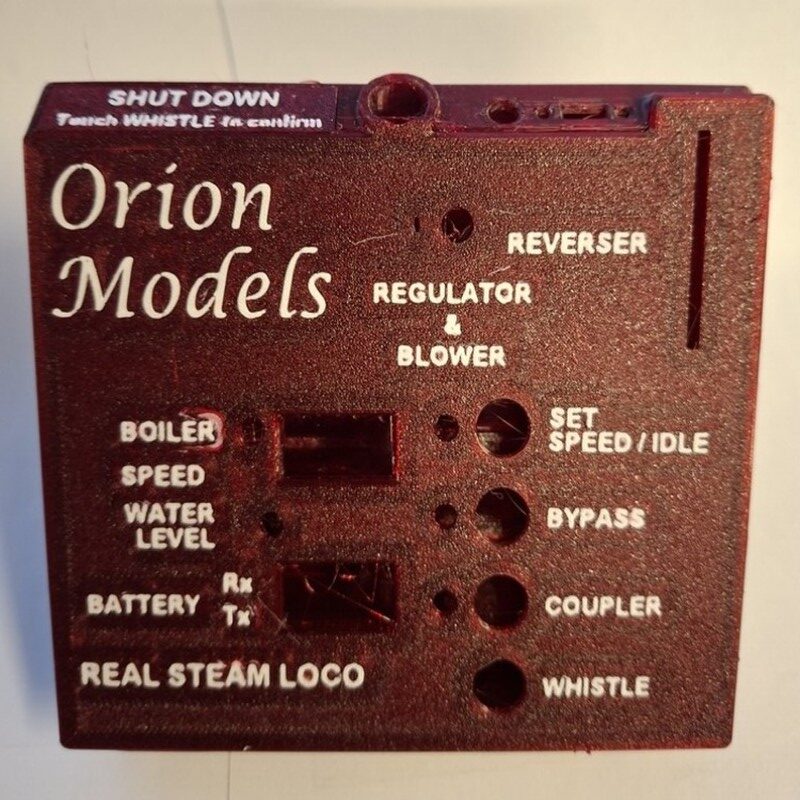
The picture below shows my R/C Tx case for my control system.
This was a first attempt at embedding text into the surface – not quite right as it seems to have dragged some white filament to the right of the word “BOILER” when printing the burgundy red.
I will try to print other parts this way. So far the only disadvantage seems to be that you can melt this material unlike resin.